Due to the larger image sensor pixel dimensions, full-frame DSLR's generally have better noise performance (S/N ratio) than smaller sensor cameras. Even when "normalized" to a particular print size, the larger sensor cameras always perform better. This is illustrated below in a comparison of S/N ratio between the Nikon V2 and the D800E (courtesy of DXO labs):
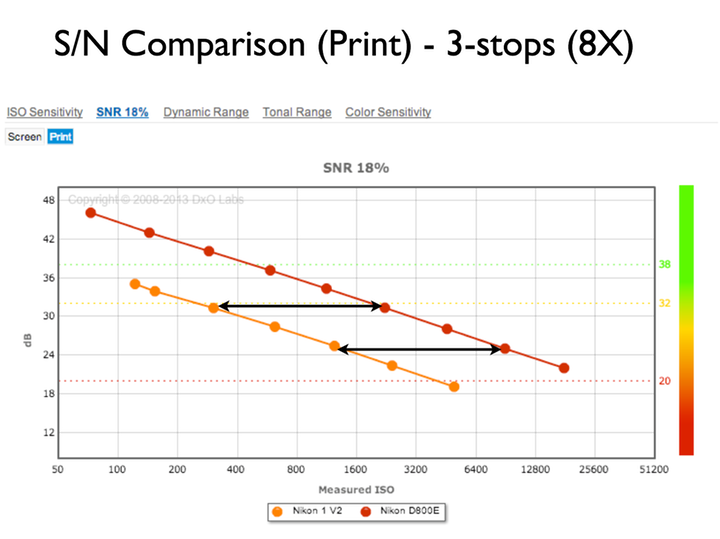
You will notice that, for a given S/N ratio (normalized for a fixed print size), the D800E has approximately 3 stops advantage. That's 8 times. Thus, ISO 200 on the V2 is roughly equivalent (in S/N) to ISO 1600 on the D800E. Per-pixel S/N is much closer but the D800E has the benefit of much higher resolution which improves S/N when downsized to print resolution. Remember this "3-stop" difference since it will arise again when we talk about Depth of Field.
As an experiment, I took pictures on both cameras of the same subject and printed them at an equivalent 8X10", 360dpi resolution. I could confirm that the noise performance was in fact, consistent with the chart above. In doing so, it looked like the maximum ISO for a good print from the V2 was 1600 and the max ISO from the D800E was 12,800. Below are crops (863 X 624 pixels) to show the similarity. While each has similar noise performance (not visible on an 8X10 print) the D800E does show some greater detail (again, not visible on an 8 X 10 print). Neither image has been noise reduced or sharpened.
Nikon V2 @ISO 1600
32mm, 1/400, f/2

Nikon D800E @ISO 12,800
50mm, 1/400, f/5.6